Release Date:2026-10-20 15:20:52 Popularity:
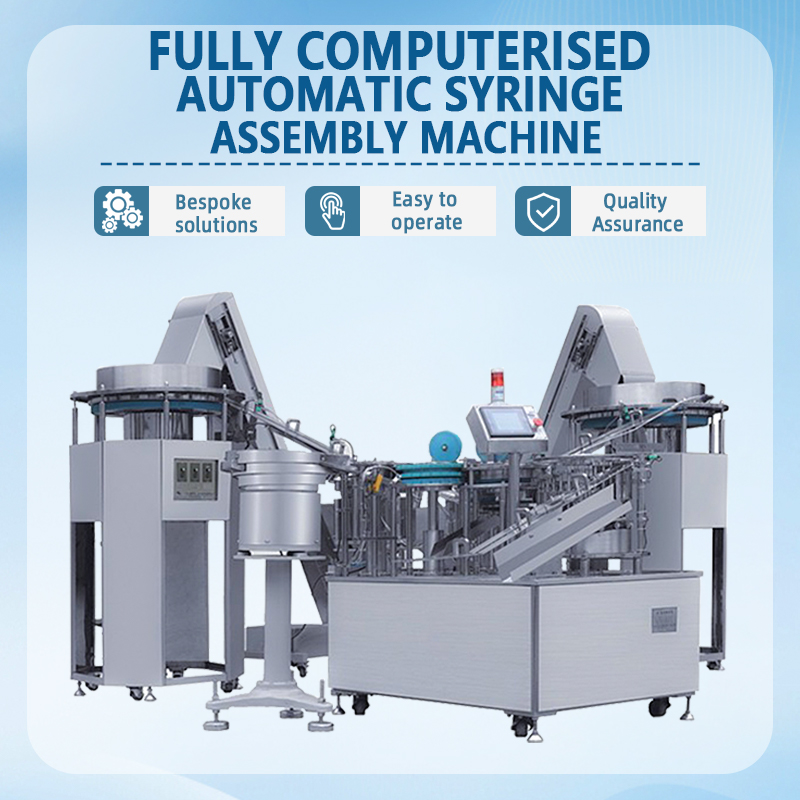
The automatic syringe assembly machine is an automated device designed for the production needs of disposable syringes. It primarily handles the automatic feeding, positioning, assembly, and output of syringe components. Depending on the product structure, production process, and customer requirements, the machine can integrate different assembly stations, achieving automated connection between multiple production stages. Common syringe components include syringe barrels, plungers, and pistons; the specific assembly process needs to be determined based on the syringe model, structural design, and process requirements. For manufacturers producing a variety of specifications, the automatic syringe assembly machine can also be customized with tooling switching, program adjustments, or custom designs to adapt to different product production tasks.

What are the advantages of an automatic syringe assembly machine?
Improving production efficiency: Automated syringe assembly machines reduce manual handling and repetitive assembly steps through automatic feeding, mechanical positioning, and collaborative workstation operations, helping to increase production cycle time and meet the needs of large-scale production. The actual capacity of the equipment depends on product specifications, assembly process, operating cycle time, and automation configuration.
Improving product assembly consistency: Automated equipment can perform positioning and assembly actions according to preset programs, reducing the impact of human error on product consistency. Depending on production requirements, it can also be configured with sensors, visual inspection, or assembly status monitoring functions to help identify missing parts, misalignments, and other abnormalities.
Reduced manual workload: Automated syringe assembly machines reduce repetitive manual operations, optimize production job allocation, and help companies reduce their reliance on manual assembly. Simultaneously, automated production also helps standardize work processes and improve the controllability of production management.
Supports production process integration: Enterprises can integrate automated assembly machines with processes such as automated feeding, online testing, conveying, and finished product collection, based on their actual needs, to form a more coherent automated production process. For projects with higher automation requirements, the feasibility of connecting the equipment with upstream and downstream processes can also be evaluated.

How to choose a suitable automatic syringe assembly machine
When selecting an automated syringe assembly machine, it is essential to first determine the syringe model, size range, component structure, and specific assembly process. Different products present varying assembly challenges, and the equipment selection should be based on actual samples and process verification.
Secondly, key considerations should be given to equipment operational stability, assembly accuracy, production cycle time, ease of changeover, and maintenance difficulty. For production projects requiring quality traceability or anomaly management, detection, data acquisition, and alarm functions can be added as needed.
Furthermore, the production of medical consumables places high demands on the production environment and product quality management. Equipment planning should take into account the company's applicable quality management system, clean environment requirements, and relevant regulations and standards to rationally determine equipment materials, structural design, and validation plans.
GST focuses on industrial automation equipment and non-standard automation solutions, providing needs assessment and solution planning tailored to clients' product structure, assembly processes, production cycles, and on-site conditions. For example, in the case of an automated syringe assembly machine project, GST can evaluate configurations such as automatic feeding, positioning assembly, online inspection, and multi-station collaboration based on actual process requirements, helping companies explore automation solutions suitable for their specific production needs.
During equipment project implementation, preliminary requirements analysis, sample testing, process verification, and equipment commissioning are all crucial. Clearly defining acceptance criteria and operational requirements helps improve the compatibility between the equipment and the actual production process.

In response to the ever-increasing demand for automation in the medical consumables industry, selecting a suitable automated syringe assembly machinecan help companies improve assembly efficiency, optimize personnel allocation, and strengthen the stability management of the production process. For companies wishing to build automated assembly stations or upgrade existing production lines, a reasonable equipment solution should be developed based on product characteristics, investment budget, and future capacity planning. Guanshengtai can conduct communication and customized evaluation of automation equipment solutions according to specific customer needs. Through reasonable equipment planning and process design, companies can gradually promote the automation, standardization, and efficiency of syringe production, providing support for sustainable development.