Release Date:2026-11-09 16:38:11 Popularity:
There is no uniform price for liquid filling machines ; the price depends primarily on the type of equipment, filling capacity, production speed, level of automation, and functional configuration. Common liquid filling machines on the market include semi-automatic liquid filling machines, fully automatic liquid filling machines, quantitative liquid filling machines, multi-head liquid filling machines, and non-standard customized filling equipment. Different machines vary in mechanical structure, metering methods, control systems, and production efficiency. For example, semi-automatic liquid filling machines typically require manual assistance for some operations and have a relatively simple structure; fully automatic liquid filling machines integrate automatic feeding, positioning, quantitative filling, and finished product conveying functions, offering a higher level of automation.

Main factors affecting the price of liquid filling machines
Types of materials to be filled: Different liquids have different physical properties, which in turn affect the requirements for filling equipment. For example, low-viscosity liquids such as water and beverages differ from high-viscosity materials such as honey, shampoo, and lotion in terms of filling mechanisms and metering methods. Equipment needs to be specifically configured according to the characteristics of the material, which will affect manufacturing costs.
Filling accuracy and capacity requirements: Different companies have different requirements for filling capacity and accuracy. Common equipment can be set with corresponding filling capacities according to product needs, and some high-precision equipment can also use flow meters, pistons, or weighing methods for metering. The higher the filling accuracy requirement, the higher the requirements for the metering system and control technology are usually.
Automation Level: Liquid filling machines can be mainly divided into two types: semi-automatic and fully automatic. Semi-automatic equipment usually requires manual assistance to place containers or start filling, while fully automatic equipment can continuously complete multiple production processes. The structural design and configuration costs of the equipment also differ depending on the level of automation.
Filling speed and production capacity: The scale of a company's production determines the operating speed of the equipment and the number of filling heads. Small-batch production can choose single-head or few-head filling equipment, while large-batch production can consider multi-head high-speed filling machines to increase production capacity per unit time.
Non-standard customization features: If a company's packaging containers have special shapes or its production processes have special requirements, it will need to customize non-standard automated equipment. For example, adding functions such as automatic feeding, anti-drip, liquid level detection, automatic capping, and vision inspection will all affect the overall price of the equipment.
If a company needs to build a complete automated bottling production line, it may also need to include supporting equipment such as automatic bottle handling, filling, capping, labeling, testing, and packaging. Therefore, the specific price needs to be evaluated based on the actual production process and equipment configuration.
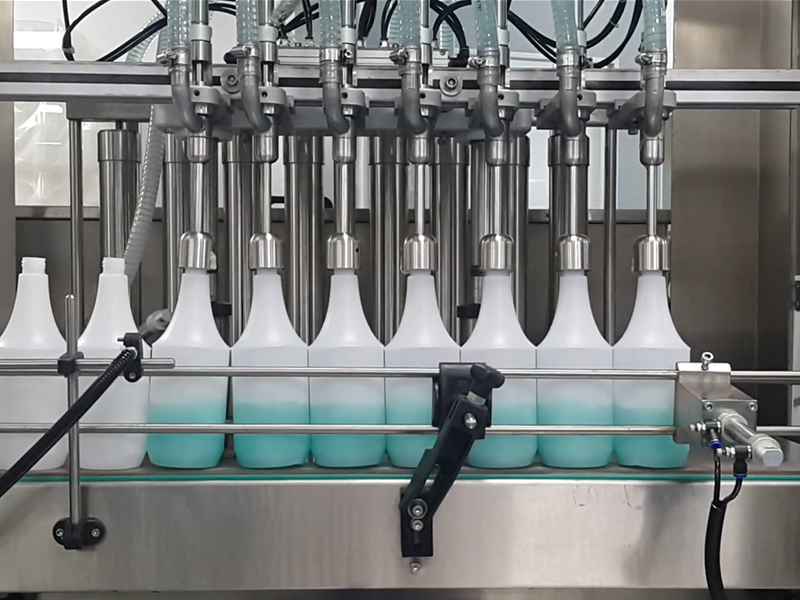
What are the advantages of liquid filling machines?
Liquid filling machines effectively reduce repetitive operations in traditional manual filling processes, improving production efficiency. Automatic quantitative control ensures more consistent filling capacity for each container, reducing liquid waste.
Meanwhile, automated filling equipment can be connected to capping machines, labeling machines, conveyor lines, and packaging equipment to achieve continuous operation of multiple processes. For companies that need to produce in large quantities over a long period, properly configuring liquid filling machines helps optimize production processes, reduce labor input, and improve product packaging quality.
When purchasing liquid filling machines, companies should not only focus on the price of the equipment, but also comprehensively consider the manufacturer's technical research and development capabilities, equipment manufacturing experience, product quality, and after-sales service.
First, the viscosity, corrosiveness, and flowability of the liquid material should be clearly defined; second, the filling capacity, packaging container specifications, and target production capacity need to be determined; finally, attention should also be paid to the material of the parts of the equipment that come into contact with the material, the metering accuracy, the operational stability, and the subsequent maintenance costs.
For special liquid products or complex production processes, it is recommended to choose a manufacturer with the capability to customize non-standard automated equipment and develop a reasonable filling solution based on actual needs.
GST specializes in the R&D and manufacturing of automated equipment and the customization of non-standard automated equipment. It can provide semi-automatic liquid filling machines, automatic quantitative filling machines and supporting automated production line solutions according to customers' product characteristics, filling processes and production capacity requirements.

The price of a liquid filling machine depends on a combination of factors, including the type of material, filling capacity, equipment speed, level of automation, and customized features. When purchasing, companies should select the appropriate model based on their actual production needs, considering both initial purchase costs and long-term operational stability and maintenance costs. GST is committed to providing manufacturing companies with professional automated filling equipment and non-standard customized services.